

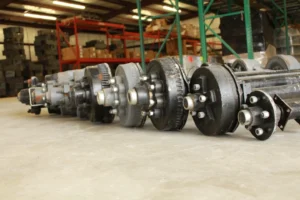
Growth Investment Partners (GIP) Ghana Ltd, an investment platform established by British International Investment (BII), has announced a strategic investment in Springs and Bolts Company Limited (SBCL), a Kumasi-based manufacturer of automotive aftermarket components. The investment will finance the acquisition of a fully automated leaf spring production line, enabling SBCL to expand production capacity from 4 to 12 metric tonnes per day while also enhancing growth efficiency. The expansion is expected to boost local capacity, reduce reliance on imports, and position Ghana as a competitive supplier of automotive components within the West African region. With regional demand for springs, bolts, and related products estimated at US$600 million annually, most of which is currently served by imports from Asia and South Africa, the investment will help strengthen Ghana’s industrial supply chains.
Jacob Kholi, Chief Executive and Investment Officer of GIP Ghana said: “There is a clear market gap for locally manufactured components that meet international standards. By backing SBCL’s expansion, we are not only scaling a competitive business but also contributing to Ghana’s broader industrialisation agenda.”
Founded in 2013, as a Free Zone Company, SBCL exports more than 70 percent of its production to ECOWAS countries such as Nigeria, Ivory Coast, Mali, and Burkina Faso, while maintaining a strong domestic presence.
Derrick Asamoah Boahen, Chief Executive Officer of SBCL, welcomed the partnership “Our goal is to position SBCL as the preferred source of high-quality automotive components in West Africa. We are proud to partner with GIP in this next phase of our growth. With increased capacity and automation, we can better serve the automotive, logistics, mining, and agriculture sectors while providing more affordable and quality alternatives to imported products”.
SBCL’s growth has been supported through partnerships with Supreme Springs of South Africa for technical expertise, GIZ for market access to logistics and mining companies, and the UK Foreign, Commonwealth and Development Office’s (FCDO) Jobs and Economic Transformation (JET) Programme for market research and expanding capacities into novel production of fasteners.
The company currently employs 28 people and is poised to expand its workforce significantly. With duty-free access under the ECOWAS Trade Liberalisation Scheme, SBCL is well-positioned to improve competitiveness across the sub-region while exploring vertical integration opportunities such as securing raw material supply chains and expanding downstream services.
“Reducing dependence on imports is not just about production capacity, it’s about building an ecosystem that supports critical supply chains across mining, agriculture, and logistics,” Boahen added.
Kwabena Asante Poku, Country Director for Ghana, British International Investment, said: “Through Growth Investment Partners Ghana, British International Investment is backing SMEs that can transform Ghana’s industrial base. Supporting SBCL’s expansion will not only reduce reliance on imports but also strengthen critical supply chains across mining, agriculture, and logistics.”
The GIP-SBCL partnership aligns with Ghana’s industrial policy goals by expanding manufacturing capacity, creating jobs, and strengthening regional supply chains.

